Official News Feature
Chitran International Has Been Featured in TechBullion
We are excited to share that Chitran International Online Art Classes LLC has been officially featured in TechBullion news. The feature, published on June 13, 2026, presents the school's development from its roots as Chitran Art School to a global online learning organization.
Read the full TechBullion featureA Journey That Began With a Local Art School
Chitran's story began on January 1, 2000, when artist and teacher MD Zubairul Islam founded Chitran Art School in Gazipur, Bangladesh. The early mission was direct and practical: help children learn drawing through patient instruction, regular practice, and clear step-by-step demonstrations.
Long before live online classes became common, the school was built through in-person relationships. Students learned how to control lines, observe shapes, understand proportion, use color, and complete artwork with confidence. Parents saw not only finished pictures but also the habits developing behind them: focus, patience, discipline, and willingness to revise.
More Than Two Decades of Teaching Experience
The TechBullion feature describes MD Zubairul Islam's long teaching career and the experience that shaped Chitran's educational approach. Years of working with children revealed a simple truth: students do not all learn at the same speed, and a difficult picture becomes less frightening when a teacher breaks it into understandable stages.
This experience remains central to the school's live teaching model. A teacher can notice whether a child is rushing, pressing too hard, beginning with details too early, or losing confidence. Correction is not only about pointing out an error. It is about choosing the next step the learner can understand and use.
Founder & Artist
MD Zubairul Islam: Teaching Through Art and Experience
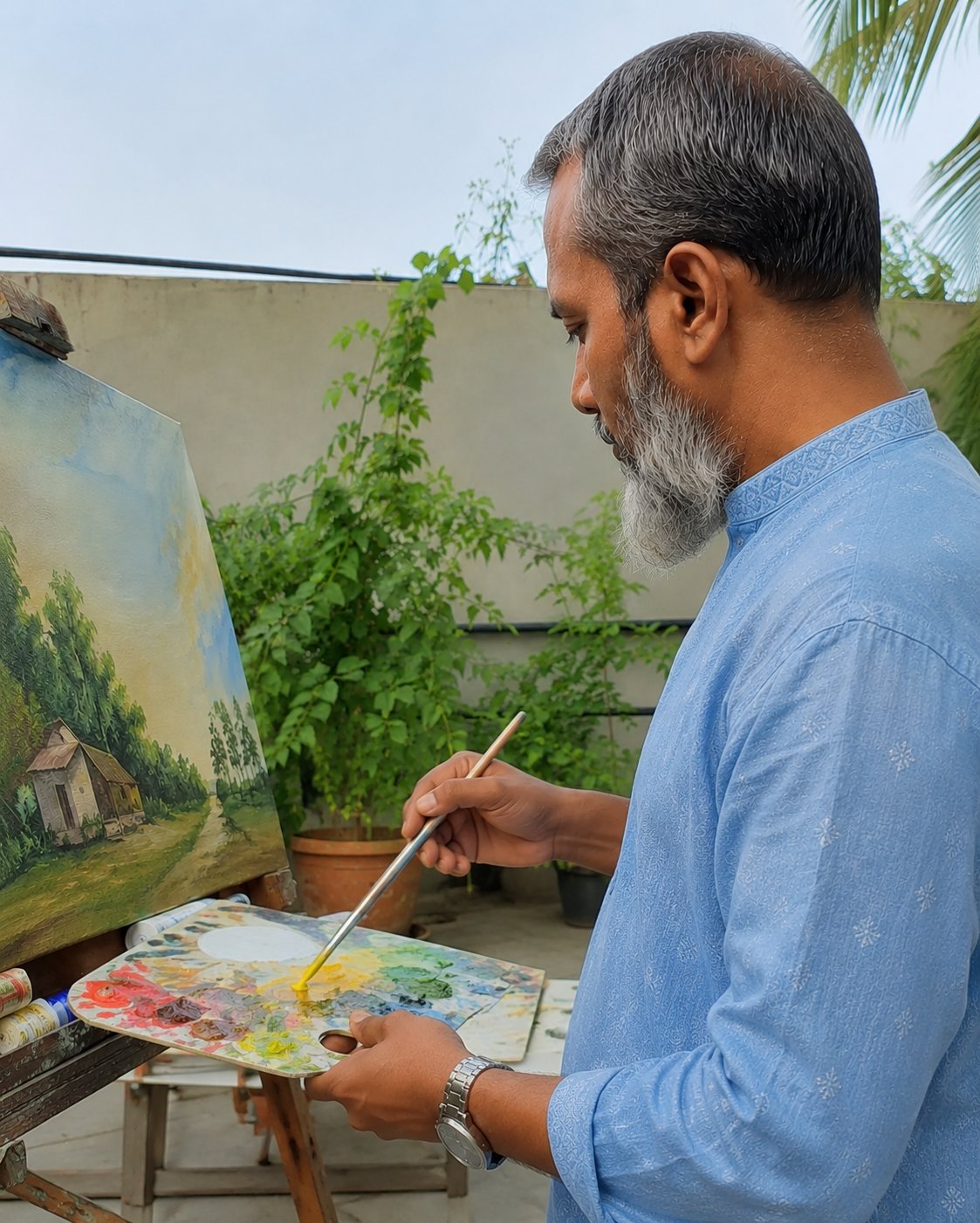
MD Zubairul Islam is the founder and main drawing teacher behind Chitran. His work connects professional art practice with child-friendly teaching. The aim is not to make every student copy one style. It is to give learners enough structure to observe carefully, use materials with confidence, and gradually make independent choices.
His journey from a physical classroom to international online teaching shows that the medium can change while the educational purpose remains steady: real-time instruction, careful demonstration, feedback, and encouragement.
The Pandemic Changed the Classroom, Not the Mission
Like many education organizations, Chitran faced a major turning point during the COVID-19 pandemic. In-person instruction became difficult, and the school had to find another way to continue helping students. The response was not simply to upload recorded videos. Chitran moved toward live online teaching so the relationship between teacher and learner could continue.
This transition required new methods. Demonstrations had to remain visible through a camera. Families needed clear material lists and schedules. Teachers needed to communicate through a screen while still observing student progress. The challenge eventually opened the classroom to families beyond the local area.
From Gazipur to Global Online Learning
Online instruction allowed Chitran to reach students in different countries and time zones. Children could join from home, prepare familiar materials, watch a live demonstration, ask questions, and receive guidance. Geography no longer determined whether a family could access the teaching approach developed over many years.
The global model also made consistency important. International families need dependable scheduling, clear communication, organized enrollment, and a continuing program rather than a collection of unrelated one-time activities. Chitran's growth therefore involved both teaching and the systems that support teaching.
Key Milestones in the Chitran Journey
What Chitran Offers Today
Live Interactive Classes
Students learn with a teacher in real time, ask questions, and receive guidance during the creative process.
Structured Skill Development
Projects connect enjoyable subjects with observation, line control, proportion, shading, color, and composition.
International Access
Families can access a continuing art program from home without depending on a nearby physical art school.
Child-Friendly Teaching
Lessons are broken into manageable steps while encouraging confidence, participation, and gradual independence.
Why Live Teaching Remains Important
Digital education can easily become passive. A child watches, pauses, and copies without knowing whether the work is developing well. Live classes add accountability and adaptation. The teacher can slow down, repeat a step, answer a question, or suggest one correction before a small problem becomes discouraging.
Human feedback also protects the child's ownership. The teacher does not need to redraw every difficult section. Instead, the student is guided to look again, compare, and make the next decision. This process helps children become learners who can eventually work more independently.
A School Built Around Creative Confidence
Chitran's philosophy is that drawing can be learned through clear explanation and practice. Some children arrive confident, while others are afraid of making a mistake. The classroom should give both kinds of students a realistic path forward.
Creative confidence does not mean telling a child that every page is perfect. It means showing that ability changes through attention, correction, and repeated effort. A dated sketchbook can make that growth visible in a way that one polished final image cannot.
What the TechBullion Feature Represents
The TechBullion publication is an opportunity to share Chitran's history with a wider audience. It records a transition that many education organizations experienced but each navigated differently: moving from a local physical model into a global digital environment.
For Chitran, the recognition also highlights the value of continuity. The online school did not appear without a teaching history. It grew from more than two decades of classroom experience, an established art-education mission, and a willingness to adapt when circumstances changed.
Original External Source
Read the TechBullion News Article
This Chitran blog post summarizes and responds to the external TechBullion feature. For the complete publication, wording, and context, visit the original source:
Open the TechBullion featureLooking Toward the Next Chapter
The future of online art education will include new devices, AI tools, digital media, and changing family expectations. Chitran's opportunity is to use helpful technology without losing the live human teaching that defines its approach.
The next chapter is not only about reaching more students. It is about helping each student observe more carefully, practice consistently, communicate visually, and experience the pride of making something through their own effort.
Be Part of the Chitran Journey
Experience live online drawing classes with structured teaching, real-time guidance, and creative projects for children learning from home.