The Big Idea
A confident child can use tools as helpers instead of permission-givers.
Why Creative Confidence In The Ai Generation Matters Now
Families are seeing a fast shift in how children meet images. Search feeds, short videos, design apps, school devices, and AI tools all shape what children think art should look like. That makes creative confidence in the AI generation more than a small hobby topic. It is part of how children learn attention, judgment, originality, and confidence.
The important point is balance. A child can enjoy modern tools and still build the slow human skills that make art meaningful: looking carefully, choosing a point of view, making marks by hand, revising a weak idea, and explaining why the final work matters.
What Parents Should Notice
Children surrounded by instant AI results may doubt their slower handmade progress.
Creative confidence grows when adults value effort, choice, and personal voice.
Parents do not need to become professional artists to guide this. They only need a clear lens: is the child making choices, noticing details, and improving through effort? If yes, creative confidence in the AI generation can become a healthy part of learning instead of another passive screen habit.
A Practical Home Routine
Begin with a small visible setup. Keep paper, a pencil, an eraser, and one color tool in the same place. Add a simple prompt card so the child can start without waiting for a perfect idea. The routine should feel easy to enter and easy to repeat.
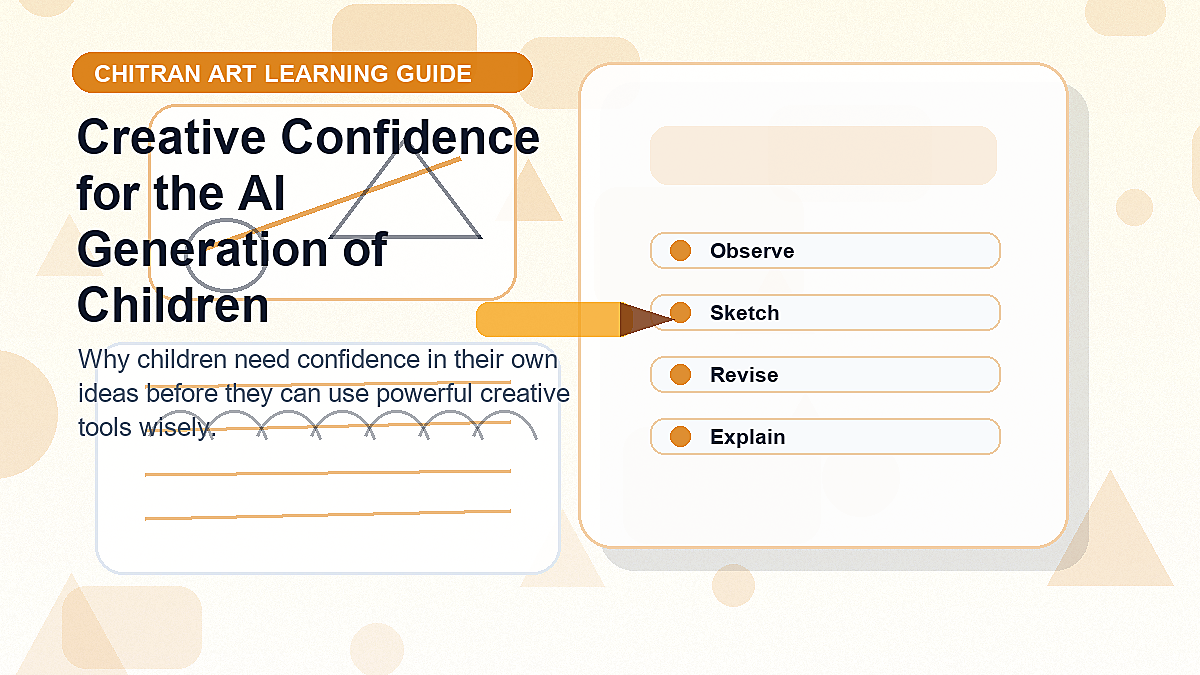
For this topic, use a three-step rhythm: first observe or imagine, then make a rough sketch, then improve one specific part. That final improvement step is where learning becomes visible. Children discover that art is not a magic result; it is a series of choices.
How Live Art Learning Helps
Live art classes give children feedback at the moment when they are forming habits. A teacher can notice when the child is pressing too hard, skipping observation, copying without understanding, or giving up too quickly. Those small corrections are difficult to get from a video alone.
In a guided class, creative confidence in the AI generation can be connected to real drawing skills: composition, proportion, line quality, color decisions, storytelling, and presentation. The child learns to think like a young artist, not just finish an activity.
Common Mistakes to Avoid
The first mistake is turning the topic into a lecture. Children learn more when adults ask curious questions and let them test ideas. The second mistake is praising only the cleanest result. That can make children afraid of rough drafts, which are often the place where original thinking appears.
Another mistake is allowing tools to remove all challenge. If a button instantly fixes every problem, the child may miss the chance to build patience. A little productive difficulty helps children feel ownership when the work finally improves.
A Simple Weekly Plan
Monday can be a five-minute observation sketch. Tuesday can be a color choice. Wednesday can be a small revision of an old drawing. Thursday can be a conversation about one image the child saw online. Friday can be a finished mini artwork or a family gallery moment.
This plan keeps creative confidence in the AI generation practical. It avoids all-or-nothing thinking and gives children many small chances to practice visual judgment during a normal week.
Questions to Ask Your Child
What did you notice first? Which part did you decide yourself? What changed from your first draft? What was difficult? What did you learn from the mistake? What would you try differently next time?
These questions make the process visible. They also help children build the language of art, which is especially important when the world is full of polished images that arrive faster than children can understand them.
Age-by-Age Guidance
For ages five to seven, keep creative confidence in the AI generation concrete. Ask children to point, name, compare, trace big shapes in the air, and make one drawing decision at a time. Young children do not need abstract explanations. They need a calm adult who helps them notice size, color, direction, expression, and story.
For ages eight to ten, add planning. Children can make two thumbnail sketches, choose a stronger composition, and explain why one idea communicates better than another. This age group often enjoys challenges, but they still need permission to make imperfect drafts.
For ages eleven to fourteen, connect creative confidence in the AI generation to identity, media, school expectations, and portfolio habits. Older children can document process, compare references, discuss authorship, and reflect on how tools change the final meaning of an artwork.
What a Strong Learning Session Looks Like
A strong session has a clear starting question. For example: what is the main shape, where is the light coming from, what emotion should the character show, or what detail proves the scene is original? This keeps attention focused and prevents the child from jumping randomly between choices.
Next comes a rough draft. The rough draft should be quick enough that the child is not afraid to change it. Parents can call it a thinking sketch, a planning sketch, or a test page. The name matters because children often assume every page must be perfect.
The final part is reflection. Reflection can be as simple as circling the best line, starring the clearest idea, or writing one sentence about what changed. Reflection turns activity into learning because the child understands the reason behind improvement.
How to Keep the Child's Voice Visible
When working with creative confidence in the AI generation, personal voice can disappear if the child only follows examples. Encourage details that come from the child's own life: a favorite snack on the table, a local tree, a family tradition, a pet habit, a remembered place, or a character with a personal backstory.
Parents can ask children to add one invented detail and one observed detail. The observed detail keeps the work grounded in looking carefully. The invented detail keeps the work expressive. Together, they help the artwork feel both believable and personal.
If a child copies a tutorial, add a second round where the child changes the setting, color mood, character expression, or object combination. This teaches children that learning from examples is useful, but ownership grows when they transform the idea.
Signs the Routine Is Working
The child starts noticing more in ordinary life: the shadow under a cup, the curve of a leaf, the shape of a shoe, or the expression in a face. This is a strong sign because observation is the root of visual intelligence.
The child becomes less upset by mistakes. They may still feel frustrated, but they begin to understand that a weak line can be redrawn, a color can be adjusted, and a confusing idea can be clarified. That shift is valuable far beyond art.
The child can explain choices related to creative confidence in the AI generation. Explanation shows that the child is not only producing an image but also building judgment. This matters in school projects, online sharing, portfolio development, and future creative work.
How Parents Can Support Without Taking Over
Use neutral noticing before advice. Say, 'I see you made the background cooler than the character,' or 'I notice the biggest shape is on the left.' This helps children look again without feeling judged.
Offer one suggestion at a time. Too many corrections can make children dependent on adult approval. A single useful suggestion protects momentum and leaves room for the child to solve part of the problem independently.
Celebrate process evidence. Keep rough sketches, rejected ideas, color tests, and before-and-after versions. These pages show growth more honestly than a single polished final image, and they help children feel proud of effort.
Classroom and Homeschool Connections
Creative Confidence In The Ai Generation connects naturally with writing, science, social studies, and digital citizenship. A child can draw a plant observation for science, design a character for writing, analyze a poster for media literacy, or create a visual timeline for history.
For homeschool families, art can become a bridge subject. A drawing session can include measurement, vocabulary, storytelling, research, and presentation. This is why art often works well for children who learn best through hands-on activity.
For school families, a short home routine can support classroom learning without adding another stressful worksheet. The child practices attention, planning, and communication in a form that feels creative.
A More Detailed Weekly Activity Menu
Day one: draw one real object from life and label three details. Day two: make three tiny composition thumbnails. Day three: choose one thumbnail and improve the main shape. Day four: add value, pattern, or color with a specific purpose. Day five: explain the finished piece to another person.
Weekend option: turn the week's work into a mini gallery. The child can title the piece, choose one draft to show beside it, and write a short artist note. This makes the process visible and helps the family value learning, not only decoration.
If the week is busy, choose only two days. Consistency is helpful, but guilt is not. A small routine around creative confidence in the AI generation should make creative life easier for the family, not heavier.
Materials, Space, and Setup
A useful art space does not need to be large. A tray, folder, clipboard, or small box can hold the basic tools and move from table to shelf when the family needs the room. Children practice more often when setup is simple and cleanup is not a battle.
Keep the first material list modest: drawing paper, one sketchbook, graphite pencils, eraser, sharpener, colored pencils or markers, and one painting option if the child enjoys color. Too many choices can slow children down, especially when the real goal is consistent thinking and practice.
For creative confidence in the AI generation, add one planning tool such as sticky notes, a simple checklist, or a folder for drafts. This turns the project into a visible process. It also helps parents and teachers see growth over time instead of judging only the final page.
How to Measure Progress Without Pressure
Progress in children's art is not always a straight line. A child may draw confidently one day and struggle the next because the subject is harder, the mood is different, or the child is trying a new skill. That unevenness is normal.
Look for process markers: better observation, longer focus, clearer planning, more willingness to revise, stronger explanations, and more personal details. These signs often appear before the finished drawings look dramatically different.
A simple progress note can help: 'Today I practiced,' 'One thing I improved,' and 'One thing I want to try next.' This keeps creative confidence in the AI generation connected to learning while protecting the joy of making art.
When to Bring in a Teacher
A teacher becomes especially useful when a child wants to improve but keeps repeating the same problem. Common examples include flat-looking drawings, rushed outlines, weak proportions, fear of shading, or frustration when copying from references.
Live feedback helps because the teacher can respond to the child's exact drawing. Instead of giving a generic tip, the teacher can show where to slow down, where to compare angles, how to simplify a shape, or how to make the next step less overwhelming.
For families exploring creative confidence in the AI generation, a teacher can also set healthy boundaries around tools, references, originality, and revision. That guidance helps children become thoughtful creators rather than children who only chase quick results.
Why This Topic Is Popular in 2026
Parents are looking for activities that feel meaningful, skill-building, and calmer than endless scrolling. At the same time, children are growing up in a visual world shaped by AI tools, social platforms, fast thumbnails, digital design, and constant image sharing.
That combination makes art education feel newly important. Drawing is no longer only a nice hobby; it is a way to build attention, visual judgment, originality, and confidence in a culture where images influence decisions every day.
Creative Confidence In The Ai Generation belongs in that conversation because it gives families a practical way to respond. Instead of rejecting technology or accepting every trend without question, children can learn to observe, make, discuss, and choose with more care.
Quick Parent Checklist
- Children surrounded by instant AI results may doubt their slower handmade progress.
- Creative confidence grows when adults value effort, choice, and personal voice.
- A confident child can use tools as helpers instead of permission-givers.
- Originality often begins with small personal details: memories, humor, favorite places, and invented characters.
Frequently Asked Questions
Is this topic only for older children?
No. Younger children can begin with simple observation, naming choices, and short drawing prompts. Older children can add deeper reflection, research, digital tools, and portfolio thinking.
How long should children practice?
Ten focused minutes can be useful when the task is clear. Longer sessions are helpful for live classes, detailed projects, and revision, but consistency matters more than occasional marathon practice.
Should parents correct every mistake?
No. Correct the habit, not every mark. Ask what the child sees, offer one useful suggestion, and leave room for personal style and discovery.
Build Creative Skill With Real Guidance
Chitran helps children draw, observe, revise, and explain their ideas through live online art classes designed for modern families.
Book a Free Demo View Class Options